
Use The Full Handbook
Open the single-page handbook when you want the whole interview story in one place: full code, diagrams, tradeoffs, and explanations.
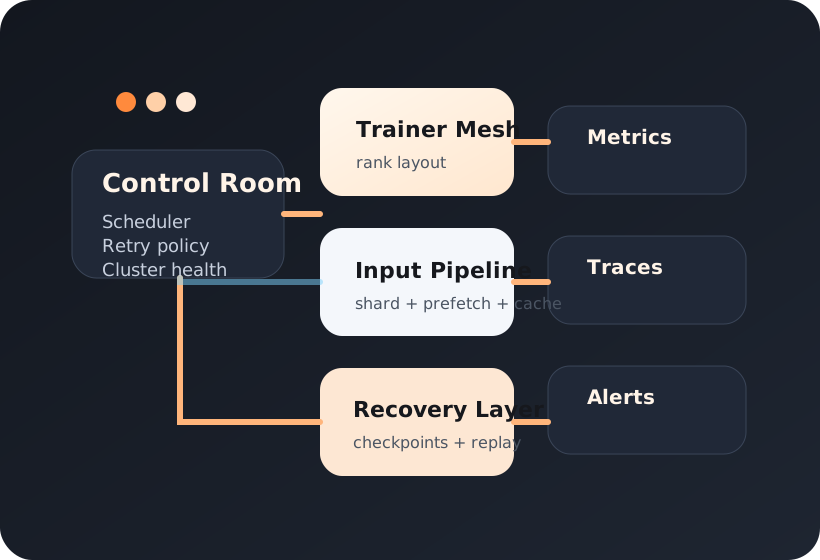
This site is organized around the exact systems questions that show up when an interviewer asks you to share your screen and build or reason about a distributed ML training pipeline:
The content has been sharpened using current official PyTorch documentation, especially the PyTorch 2.11 docs for DDP, FSDP, torchrun, torch.utils.data, AMP, activation checkpointing, and Distributed Checkpoint.
flowchart LR
  A[Colab Prompt] --> B[Single node prototype]
  B --> C[Distributed trainer]
  C --> D[Failure handling]
  D --> E[Monitoring and cost posture]
  E --> F[Staff-level tradeoff discussion]
Use The Full Handbook
Open the single-page handbook when you want the whole interview story in one place: full code, diagrams, tradeoffs, and explanations.
Start With System Shape
Read the architecture and parallelism sections first. Most candidates lose time because they start with APIs instead of process topology and failure domains.
Practice Explaining Tradeoffs
The hard-questions section is written to train the narration layer: why this approach, what breaks first, and what you would instrument before scaling.
Translate Theory Into Notebook Code
The Colab drills turn high-level design into pseudocode and production-shaped training loops so you can explain while typing.
Stay Current With PyTorch
The official-reading section points back to current PyTorch docs so you can refresh on the actual API and runtime guidance instead of memorizing stale blog posts.
0. Full Handbook
If you prefer one continuous deep-dive, start with the all-in-one page and use the rest of the site as drill-down reference.
1. Interview Map
Understand what the interviewer is trying to measure and what a strong answer sounds like.
2. Foundations
Work through the trainer architecture, rank topology, and parallelism playbook.
3. Reliability + Perf
Study how throughput fails, what restart safety really means, and how to measure both.
4. Notebook Walkthrough
Practice building the design from scratch as if the Colab notebook were the interview.
5. Hard Questions
Use the Q/A section to pressure-test whether you can defend the design under pushback.
| Dimension | Weak answer | Strong answer |
|---|---|---|
| Failure model | ”I would retry the job." | "I would distinguish rank-local faults, node loss, storage stalls, and communicator-wide poison states because each one changes restart scope.” |
| Performance model | ”I would scale horizontally." | "I would first separate loader starvation, network contention, kernel inefficiency, and optimizer-state memory pressure.” |
| Data correctness | ”Shard the dataset." | "Shard deterministically, track global sample progress, and prove resume does not silently replay or skip samples.” |
| Staff signal | ”I know DDP and FSDP." | "I can explain why I would pick one, what operational cost it creates, and what metric would tell me the decision is wrong.” |
torch.utils.data docstorchrun docsBiotech ML roles layer domain-specific correctness problems on top of standard distributed training. These sections cover the additional ground.
Molecular Data Pipelines
Scaffold splits, variable-length sequence collation, molecular graph batching, sparse genomic data, class imbalance in bioassay datasets, and the metrics that reflect biological reality instead of mathematical convenience.
Sequence and Structure Modeling
Protein language model training at scale, sequence parallelism for long sequences, quadratic pair-representation memory in structure prediction, SE(3)-equivariant network constraints, and multi-task training across sparse assay labels.
Biotech Hard Questions
Domain-specific pressure questions on data leakage, active learning loops, wet lab feedback, de novo generation distribution shift, and geometric constraints that change data pipeline design.
Two long-form walkthroughs connect the site’s DDP, data-plane, and performance guidance to concrete large-dataset scenarios: